
240.8K
Downloads
90
Episodes
Equality, Diversity and plain good sense for the 21st Century
Episodes
Tuesday May 21, 2013
Tuesday May 21, 2013
They will be running educational events nationwide using the video as part of the overall package.
They will also be teaching GPs and CCG leaders about established best practice ideas for reaching out to men and boys.
But the video material could also be used on its own too, to encourage GPs (in particular) to think differently about how to reach men and boys.
Expert contributions
The 75 minute film includes some great contributions by MHF and European Men's Health Forum President, Professor Ian Banks; MHF Trustee and epidemiologist Professor Alan White; and former MHF Chief Executive, Peter Baker, who now works as an independent consultant in this field.
We hope it will be widely used.
Tuesday May 21, 2013
Tuesday May 21, 2013
Last month, over on the blog, I explained how we had managed to complete our Disability History Timeline at NHS North West, before the organisation was disbanded as part of the NHS reorganisation on 31st March.
The timeline is similar to our previous Black and Minority Ethnic and LGBT peoples' histories, in that it consists of three parts: a mobile exhibition, a printed booklet and a video.
The booklet was printed in March and the timeline panels were similarly completed in time, as a result of heroic efforts by my colleague Loren Grant. However, although we had also completed the video, we weren't ready to release it at that time, as it needed to go to the specialist organisation who add British Sign Language signing.
The video is now completed … in time for a public launch of the whole resource at the headquarters of Greated Manchester Commissioning Service Unit (GMCSU) on Wednesday 8th May. As NHS North West's online resources are now all closed I have also agreed to host an online version of the film on the Plain Sense platforms.
The film runs for just over 20 minutes and is signed throughout. It is in two parts. In the first section disabled people talk about their personal experiences of the NHS. In the second half disabled NHS staff talk about disability from their own perspective. A short section at the end also explains how we worked with stakeholders to coproduce the whole resource.
Click here to download the booklet.
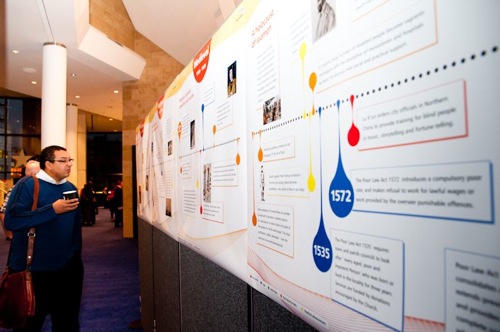
The draft timeline was first showcased at our
special legacy event in December 2012
Monday May 20, 2013
Monday May 20, 2013
Alice Purnell OBE is an important contributor to the development of the trans community in Britain. She was involved in founding the Beaumont Society in the 1960's; founded the Gender Trust in 1990; and instituted a groundbreaking series of biennial conferences bringing trans people and clinicians together that same year. In this extended interview, on her 70th birthday, Alice speaks openly about her own childhood; the experiences which moulded her approach towards community support; and those pivotal developments in which she had a leading role.
Saturday Sep 22, 2012
Saturday Sep 22, 2012
Paris Lees appeared in an earlier edition of Just Plain Sense about the signing of a Memorandum on trans people at Channel 4. Even then she was probably not all that well known outside of a small circle, having only moved to London the previous year. These days she is rapidly emerging as a rising star. She has quickly established herself as an art reviewer and commentator on issues of diversity. Her writing has appeared in the Guardian and the Independent, in Attitude magazine, and in Pink News. She has regular columns in Gay Times and Diva. She has appeared on Radio One and BBC TV ... and acted as a consultant on several programmes about trans people. Most notably, she launched a unique magazine, META, earlier this year. Paris recently won the title 'LGBT Role Model' at the National Diversity Awards. This interview was recorded with her the following morning whilst she was still getting used to the recognition.
Saturday Jul 16, 2011
Saturday Jul 16, 2011
In this episode I've been into the archives to retrieve two presentations by myself and the well-known US trans personality Kate Bornstein in June 2007, as we shared the stage opening the UK's first "Transfabulous" conference. You can read a report about that whole conference here Kate and I were the 'bookends' to an introductory session, in which the facilitators of each of the day's four workstreams described what they aimed to cover. We both set out in our different ways to set the mood...
Tuesday Jul 12, 2011
Tuesday Jul 12, 2011
July 16th will mark the thirtieth anniversary of a campaign supporting what became known as the 'Bradford Twelve'. On that day in 1981 a dozen young Asian men from the United Black Youth League were arrested in dawn raids across the city and charged with conspiracy to make explosives and to cause explosions. The case was set against a backdrop of racist attacks on black and asian communities in Britain, which the Police had done little to address. The defendants asserted that "Self defence is NO offence" and the hearing of their case lifted the lid on racism in Britain at that time. Shahnaz Ali was a teenage girl at the time and was very much involved in the United Black Youth League in Bradford. She was taken for questioning and came close to being charged with conspiracy herself. Now a senior public sector official, Shahnaz looks back on those events with me, and describes what it was like to almost become the thirteenth defendant.
Thursday Mar 17, 2011
Thursday Mar 17, 2011
On the evening of Monday 14th March 2011 the organisation Trans Media Watch collaborated with Channel 4 TV to launch a new Memorandum of Understanding to an audience of media people, politicians and trans people. The goal of the memorandum is to help eliminate discrimination relating to trans people in all media by setting out goals that all the parties can aspire towards. Channel 4 were the first organisation to subscribe to the principles. The MOU doesn't call for censorship but aims instead to give media organisations the tools they need to address endemic problems. Trans Media Watch say they are guided by the basic principle that they wish to see transgender people and issues treated with accuracy, dignity and respect. Just Plain Sense was there to capture the atmosphere of the event, including speeches by Minister for Equalities, Lynne Featherstone MP, Stuart Cosgrove from Channel 4 and reactions from the audience. Listen to the show online with the player below or click one of the options on the right to download into your favourite music player or feed reader. You can also read more background on the Just Plain Sense Blog
Saturday Feb 12, 2011
Saturday Feb 12, 2011
Professor Joan Roughgarden is no ordinary biologist - and no ordinary trans woman either - though there are quite a few high academic achievers within the world wide community of gender variant, transgender and transsexual people. Joan is perhaps best known for her 2004 book “Evolution’s Rainbow” - an academic work, written in a language accessible to the public. In it she challenges Darwin’s theory of Sexual Selection. Her subsequent book, “Evolution and Christian Faith: Reflections of an Evolutionary Biologist”, published in 2006, showed that her willingness to take on controversial subjects was, if anything, stronger and more confident ... despite the inevitable way in which her critics responded to the first. This interview was originally recorded for another channel in the summer of 2007, but hasn't been aired on Just Plain Sense before. In the course of conversation Joan reveals an unexpected debt of gratitude to former US Secretary of State Condoleezza Rice and talks about her biologist's view of sexual orientation. Note that this show features a new, alternative, signature tune that I'm trying out. I'd appreciate listeners' feedback on whether you like it or prefer the traditional one. The theme is "New Ways of Seeing", composed and performed by Richard Harvey in 1978
Thursday Feb 03, 2011
Thursday Feb 03, 2011
I’ve covered a lot about crime in various forms over nearly three years of these Podcasts. A lot has been said about hatred directed towards Lesbian, Gay, Bisexual and Trans People. We’ve also covered domestic violence, which is mostly directed towards women. None of these subjects are pleasant. Yet the hatred which seems the hardest to understand is that which is directed towards disabled people and those with Mental Health problems or Learning Difficulties. The question why people behave so awfully in the first place tends to be brushed aside. And it’s clear that the unease that society as a whole has in this area is perhaps the elephant in the room. In this episode I talk to Karen Machin, a campaigner in this field. She and her colleagues work to raise awareness about disability hate crime and how to report it. She also works with the ‘Time to Change’ campaign, educating people about Mental Illness and she’s been involved in setting up the ‘ROLE Network’ - which is open to anyone who has experienced or supported someone through these kinds of distress or mental health issues.
Saturday Dec 18, 2010
Saturday Dec 18, 2010
What do you think about minority groups like transgender people? Unless you actually know someone in person, have you ever questioned where your beliefs and opinions come from? Chances are, like most people, what you believe and think can be traced back to what you've gleaned from media coverage. The issue of media representation is nothing new. Study the history of any minority which has struggled for equality and you'll generally find that such issues have been of concern to those who were engaged bringing about social change. Juliet Jacques is a transsexual writer and journalist who has thought a lot about these questions in her own context. She is writing a groundbreaking fortnightly column for the Guardian newspaper, documenting her own transition. She is therefore ideally placed to offer some perspectives on how the communication problems arise, and how to address them. Since this show was recorded Juliet has blogged some more detailed thoughts about some of the topics we covered. Please also feel free to build on this discussion through the comments below and on her blog
Wednesday Nov 10, 2010
Wednesday Nov 10, 2010
On November 20th or 21st those who care will be coming together in dozens of cities around the world to remember transgender people who have been murdered, often brutally, just because they are different. The event is held in November each year to honour Rita Hester, whose murder on November 28th, 1998 kicked off the “Remembering Our Dead” web project and a San Francisco candlelight vigil in 1999. Rita Hester’s murder — like most anti-transgender murder cases — has yet to be solved. This audio tribute is our contribution to those events, recorded with the generous assistance of colleagues and local broadcasters. To find out more about International Transgender Day of Remembrance and a vigil near you visit the web site: http://www.transgenderdor.org/
Monday Oct 18, 2010
Monday Oct 18, 2010
Side two of the 1977 satirical political revue, "The Cuts Show" by CounterAct. On this side: education and housing cuts; the climate of 'divide and conquer' (my cut's worse than yours); finding scapegoats among immigrant communities; the role of the press; and the capricious nature of investors. This week Chancellor George Osborne unveils what are expecting to be massive spending cuts. Yet we've been here before...
Friday Oct 08, 2010
Friday Oct 08, 2010
If you’ve ever visited Manchester City Centre then you may have noticed some small rainbow coloured mosaics set into the pavement here and there. These pick out the landmarks in Manchester’s LGBT Heritage Trail. In this show I speak to guide Jon Atkin about the background to the trail and then we visit a couple of the landmarks. If you're interested in organising a tour for a group of friends then call the Manchester Tourist Information Line on 0871 222 8223
Saturday Sep 25, 2010
Saturday Sep 25, 2010
When Nadia Almada first teetered into Channel Four's Big Brother house on impossibly high heels, in the summer of 2004, TV viewers in Britain had probably never seen more than a few minutes of any real transsexual person on their screens before. Activists and lawyers at the time were nursing Britain's Gender Recognition Bill through Parliament, and there was momentary concern about what kind of person this unknown quantity was. They needn't have worried. Within days the young Portuguese woman soon had people's attention, as her immense personality, piercing laugh and manifest vulnerability took viewers on a roller coaster ride of emotions, in which her transsexual background was sometimes the focus but often pushed to the background by other dramas. Nadia won that fifth series of Big Brother in a landslide victory that carried millions on a wave of emotion, sharing her dramatic realisation of public acceptance. In 2010 Nadia returned to Big Brother for a celebration show with other popular or controversial housemates. The return was not such a happy event. Three weeks after that event she agreed to give an in-depth interview and talks here about her childhood, changing gender, those television experiences and much more too.
Friday Sep 10, 2010
Friday Sep 10, 2010
The first LGBT Health Summit took place at Guys Hospital in London in 2005 and, since then, this major annual conference has been hosted around the country. In this fifth year the hosts were Hertfordshire Partnership NHS Foundation Trust, and the venue was the excellent conference centre at the University of Hertfordshire in Hatfield. In this programme you can hear the organisers, presenters and delegates describing the proceedings as they took place over the 6th and 7th of September 2010